
Call for two PhD Positions under the Global Health EDCTP3 Joint Undertaking, funded Digital Dashboards in Diagnostic Innovations (DiDiDi) Project.

Institutions
Leiden University Medical Center (LUMC), The Netherlands, The University of Glasgow, Scotland, UK, Makerere University (Mak), College of Veterinary Medicine, Animal Resources and Biosecurity (COVAB) and College of Computing and Information Science Kampala, Uganda.
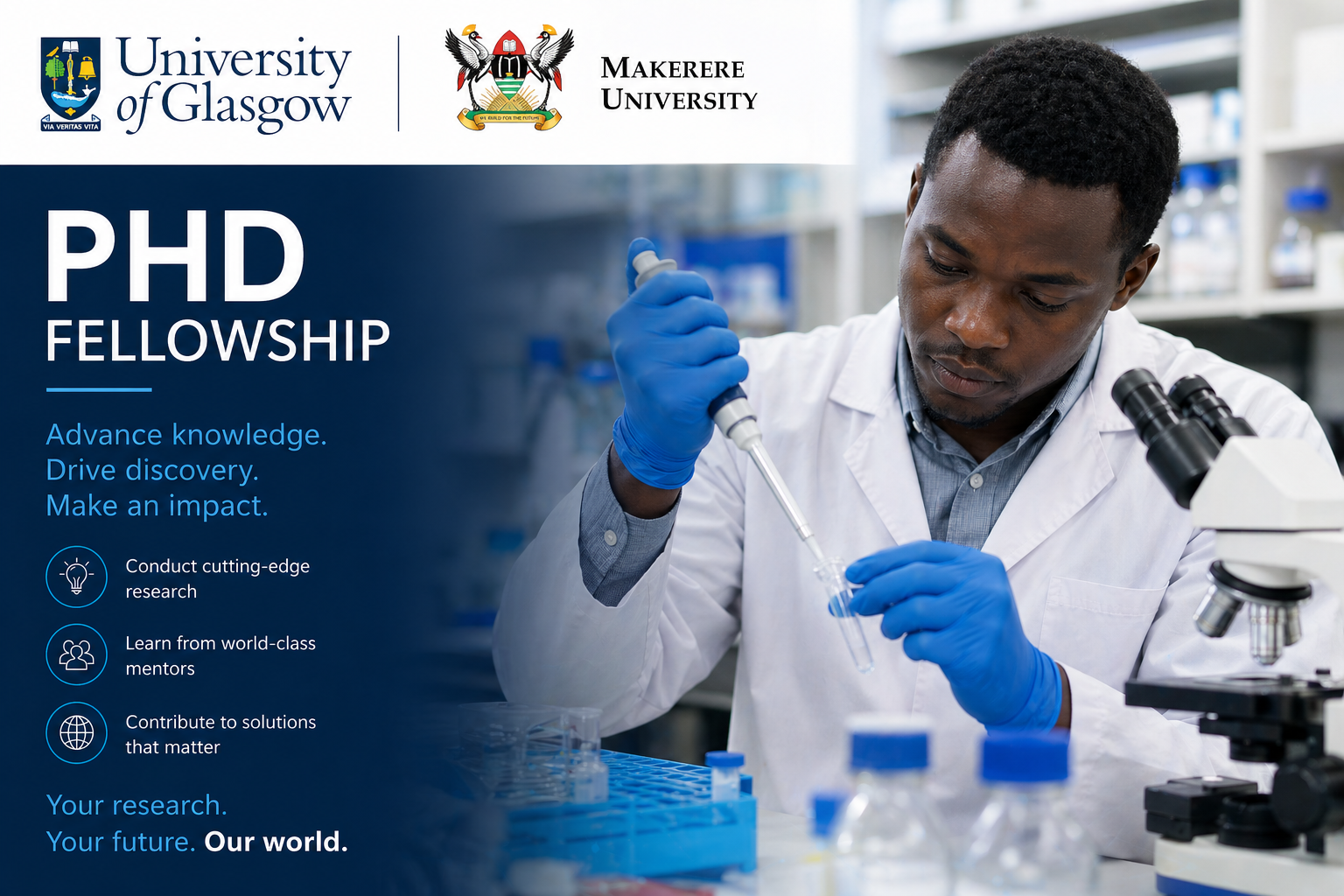
Makerere University (Mak) in collaboration with The Leiden University Medical Center (LUMC) and The University of Glasgow, Scotland, UK invites applications for two PhD positions. The PhD position is under our four (4) year (2026-2030) funded project by Global Health EDCTP3 Joint Undertaking and implemented through EU Funding & Tenders Portal under project name: Digital Dashboards in Diagnostic Innovations (DiDiDi) involving 16 research partner institutions from 6 countries, including LUMC, The University of Glasgow and Makerere University.
Project background
Digital Dashboards in Diagnostic Innovations (DiDiDi) focuses on developing secure digital dashboards to understand disease prevalence and to target new interventions for the treatment of these poverty related helminth infections. Schistosomiasis and soil‑transmitted helminth infections remain major public health challenges in Uganda and other endemic regions. Accurate and scalable diagnostic tools are essential for targeted treatment, monitoring of control programs, and progress towards elimination. The project has a specific focus on government and regional health surveillance systems, meteorological data collection and predictive models.
PhD Position 1: Field-evaluation of diagnostic innovations for schistosomiasis and Soil‑Transmitted Helminth infections in Uganda
Within the DiDiDi consortium, this PhD project specifically contributes high‑quality field and clinical validation data to support the development and evaluation of digital diagnostic dashboards. The goal for the PhD is to collect and analyse clinical and field data in Uganda and to validate conventional diagnostic approaches against innovative digital diagnostics and environmental risk factors. The work will contribute to a better understanding of infection dynamics and to the development of improved diagnostic and surveillance strategies in endemic settings in low‑ and middle‑income countries (LMICs).
to conduct doctoral research on the diagnosis of schistosomiasis and soil‑transmitted helminth (STH) infections in endemic settings.
Research objectives
The PhD candidate will focus on:
- Collection of clinical and parasitological samples (e.g. stool, urine) in communities in Uganda living in regions endemic for schistosomiasis and soil-transmitted helminth infections;
- Evaluation and comparison of classical diagnostic methods (e.g. microscopy‑based techniques) with innovative digital and image‑based diagnostics, as well as immunological and DNA‑based laboratory methods;
- Validation of field‑based diagnostic data in collaboration with LUMC-based experts in the field of innovative diagnostics of parasitic helminths;
- Integration of field data with environmental, ecological and geospatial data to assess infection risk and transmission patterns;
- Translation of findings into recommendations for improved diagnostic and surveillance strategies.
Training and mobility
- The PhD candidate will be primarily based at Makerere University and will be registered as a sandwich PhD candidate within the Leiden University PhD system, under joint supervision from Makerere University and LUMC;
- While the majority of the research and fieldwork will be conducted in Uganda, the candidate will visit LUMC approximately once per year for 1–2 months for obligatory course work and advanced laboratory analyses, training, data analysis and supervision;
- The project strongly contributes to local capacity building in parasitological diagnostics and field epidemiology at Makerere University;
Employment and funding
- The PhD candidate will be employed by Makerere University as a research fellow under the project.
- All employment condition, salary payments and local travel arrangements will comply with both Makerere University regulations and European Union funding requirements.
- Work‑related international travel, including periodic research visits to the Netherlands, will be facilitated subject to and in compliance with European Union funding regulations.
- The estimated time track to complete an PhD at the LUMC is 48 months.
Candidate profile
We are looking for a candidate who:
- Holds a completed MSc degree in Biomedical Sciences, Veterinary Medicine, Public Health, or related fields;
- Has a strong interest in tropical infectious diseases, particularly helminth infections;
- Has experience with demonstrated ambitious enthusiasm for fieldwork in Uganda as well as interests in diagnostics, epidemiology, public health;
- Is able to work independently and collaboratively in an international research environment;
- Has good spoken and written English and is fluent in local languages as needed;
- Is willing to conduct extensive fieldwork in Uganda combined with periodic research visits to the Netherlands;
- Is willing to travel to and liaise with teams in Kenya working in digital diagnostics, as well as health economics;
- Is able to start on a short notice.
What we offer
- A fully funded PhD position within an internationally recognized research collaboration.
- Training in parasitology, diagnostics, digital health tools and epidemiology.
- Access to laboratory facilities and expertise at both Makerere University and LUMC.
- Participation in PhD training programs at the LUMC Graduate School.
- Opportunities to publish in peer‑reviewed journals and present at international conferences.
PhD Position 2: Developing Machine Learning for Microscope Decision Support for Schistosomiasis and Soil‑Transmitted Helminth infections in Uganda
Within the DiDiDi consortium, this PhD project specifically contributes high‑quality field and clinical validation data to support the development and evaluation of digital diagnostic dashboards. As part of this programme, we are further developing low-cost automated microscopy that can be readily deployed in community settings. The goal for the PhD is to develop computationally low-resource mobile phone-based machine learning and AI algorithms to analyse field data. The work will involve the opportunity to collaborate with industrial partnerships based in Uganda and Europe. The overall aim of the project will be to contribute to a better understanding of infection dynamics and the development of improved diagnostic and surveillance strategies in endemic settings in low‑ and middle‑income countries (LMICs).
Research objectives
The PhD candidate will focus on:
- The development of machine learning methods to analyse clinical and parasitological samples (e.g. stool, urine) in communities in Uganda living in regions endemic for schistosomiasis and soil-transmitted helminth infections;
- Evaluation and comparison of classical diagnostic methods (e.g. microscopy‑based techniques) with innovative digital and image‑based diagnostics, as well as immunological and DNA‑based laboratory methods;
- Validation of the automated field‑based diagnostic data in collaboration with partners within DiDiDi;
- Translation of algorithms and software into mobile phones and microscopes, integrating secure data transmission through Cloud based systems and-or DHIS2/HISP Uganda
- Integration and dissemination of software and hardware tools with partners in Kenya, including local KISP and Public Health stakeholders
Training and mobility
- The PhD candidate will be primarily based at Makerere University and will be registered as a joint PhD candidate matriculating at The University of Glasgow, under joint supervision;
- Whilst the majority of the research and development will be conducted in Uganda, the candidate will visit Glasgow approximately once per year for 1 month for advanced laboratory analyses, training, data analysis and supervision;
- The project strongly contributes to local capacity building in parasitological diagnostics and field epidemiology at Makerere University;
Employment and funding
- The PhD candidate will be employed by Makerere University as a research fellow under the project.
- All employment condition, salary payments and local travel arrangements will comply with both Makerere University regulations and European Union funding requirements.
- Work‑related international travel, including periodic research visits to the Netherlands, will be facilitated subject to and in compliance with European Union funding regulations.
- The estimated time track to complete an PhD at the LUMC is 48 months.
Candidate profile
We are looking for a candidate who:
- Holds a completed MSc degree in Computer Science, Information Science or Data Science, Communications or related digital health cross-disciplinary fields;
- Has a strong interest in microscopy, digital health and diagnostics in assessing the prevalence of tropical infectious diseases, particularly helminth infections;
- Can demonstrate and evidence an ambition and enthusiasm for implementation and translation with stakeholder partners;
- Is able to work independently and collaboratively in an international research environment;
- Has good spoken and written English and is fluent in local languages as needed;
- Is willing to work alongside fieldworkers in Uganda, combined with periodic research visits to the Kenya and UK;
- Is able to start on a short notice.
What we offer
- A fully funded PhD position within an internationally recognized research collaboration.
- Training in machine learning and digital health tools in digital health.
- Access to computation facilities and expertise at both Makerere University and Glasgow University.
- Participation in PhD training programs at the Glasgow University Graduate School.
- Opportunities to publish in peer‑reviewed journals and present at international conferences.
Application Process
Interested candidates should submit:
- A motivation letter describing research interests and suitability for the project;
- Curriculum vitae.
- Only apply for one PhD track
Following a first selection round, potential candidates will be asked for:
- Copies of academic transcripts and degree certificates;
- Names and contact details of at least two academic referees.
A first round of interviews is likely to take place in Kampala on May 17th or 18th.
Submission Process
Submit your application to the project contact person at Makerere University, Associate Professor Lawrence Mugisha via email: mugishalaw@gmail.com not later than 7th May, 2026. For PhD 1, copy in E.A.van_Lieshout@lumc.nl while for PhD2 copy in jon.cooper@glasgow.ac.uk
Only shortlisted candidates will be notified for the 1st phase of the interview.